On Monday, I'm heading out for the third and final time with a team of students to Moldova to partner with the IFES movement there, CSC.
I'm a swirl of emotions as I prepare to return to Moldova. It's been a hard period of sad goodbyes to friends in Lancashire, and the past few weeks have been quite demanding. The whole setup in Moldova means that you are made to feel weak. I'm already feeling weak and so I'm somewhat nervous about how I might cope this year.
At the same time, I'm aware of how amazing an opportunity we have in Moldova. The main part of the camp is resourcing an 'English and Bible Camp' where there will be about 60 Moldovan students (including 40 non-believers) who come to practice conversational English and study the Bible. We're using The World We All Want evangelistic Bible overview and I'm excited to see the impact this makes in the Moldovan context.
Please pray for us. We're a big team with an extraordinary amount of diversity. Pray that this acts to underline the truth of the gospel that we are proclaiming, rather than act as something that undermines team unity. Pray that we're not ashamed of the gospel, that the British team grow in their knowledge and love of Jesus, and that God draws people to himself.
I'll try to update from Moldova, but this might not be possible.
Itinerary:
29th June: team meets in Luton
30th June: early morning flight from Luton to Bucharest, then travel by coach to Chisinau
1st July: arrive early morning in Chisinau; team orientation lasts until 6th July
6th-15th July: on the English and Bible camp
15th-16th July: team members stay with Moldovan hosts
I've been thinking a bit recently about a subtle form of legalism which I think seems to be common in many evangelical churches.
The argument runs a bit like this:
Unbelievers will have the gospel commended to them by Christian behaviour, and so will want to ask questions of Christians.
Therefore make an effort to impress non-believers by your behaviour - this might take various forms: be outgoing, be generous at work, arrive early at church to chat to newcomers... and so on.
It's certainly true that lifestyle commends the gospel. But I feel uneasy when I hear this sort of teaching. Here's why:
1. It seems to forget or sideline the place of grace. Titus 2, for instance, speaks of how different groups can commend the gospel through the way that they live - older men, older women, younger men and slaves. But the whole chapter is bound up with a theology of grace: Titus 2:11-14. The gospel of Christ (and the redemption in full from sin that he has achieved) gives a Christian a whole new perspective and teaches them to say no to ungodliness. The chapter is bound up with Jesus and his grace, not merely with exhortation. 2. For this reason, the implication of the above exhortation without grace is that Christians should try hard to be something that they are not really e.g. friendly, outgoing, generous. These actions are stripped away from the salvation we have received in Christ. 3. This effectively relegates godliness to a place where it is not much more than a piece of bait that can be dangled before non-believers to win conversations. 4. It also is likely to promote self-righteousness and/or despair amongst believers as they seek to strive towards these outward forms of behaviour. This behaviour is not coming from believers' hearts, and it ignores the empowering of the Holy Spirit. 5. This emphasis means that believers consider that if they show non-believers their sin, they've blown it forever.
There is a missing stage to the above teaching...
Jesus' gospel of grace has freed you and empowers you to live a life of love.
Unbelievers will have the gospel commended to them by Christian behaviour, and so will want to ask questions of Christians.
Therefore, be what you are called to be - loving Christ above all, and therefore radically seeking to meet the needs of others, trusting that all your needs will be supplied by Jesus. Be confident in the transforming power of Jesus to commend itself, even in someone as sinful and broken as you.
Looking for Eric is an unlikely but enjoyable collaboration between footballer-turned-actor Eric Cantona and director Ken Loach.
The story centres around Eric Bishop, a postman whose life has spun out of control. Failed marriages, teenage stepsons that he can't control and other complex family relationships drive Eric to the point of breakdown. Desperate for comfort and escapism, he turns to smoking his son's marujuana, and soon starts receiving visions of his hero, Eric Cantona.
The film oscillates between some light humour and a very gritty depiction of life in Manchester's social underclass. John Henshaw is brilliant as Meatballs, the leader of Eric Bishop's friendship group of postal workers. There's some real wit and brilliantly observed banter, especially between the this crowd of friends. (Two scenes stand out in particular: the session reading Paul McKenna's self help manual in Eric Bishop's lounge, and the scene of Manchester United related banter in a pub, where some knowledge of the Malcolm Glazer takeover helps).
I'll now add a spoiler alert - if you're going to see the film, stop reading now. After saying that the person with most charisma and charm he admires is Cantona, Eric Bishop's visions of Cantona lead him to act as Cantona apparently would in each situation he faces. As Eric Bishop learns to see his circumstances through the lens of the character of Eric Cantona, his choices change. The vision of Cantona encourages Eric Bishop to be spontaneous, to be passionate, to take risks, to trust in team-mates and never to give up when knocked down. There's a couple of sideways references to Cantona's mysterious pseudo-philosophy. The final scenes, in particular, represent Cantona (acting through Eric Bishop) as a big-hearted maverick rather than a crazed individual (as he was often portrayed in the media, especially after the infamous kung-fu kick).
The audience is forced to ask the question: what would Eric Cantona have been like in any other sphere of life, other than a professional footballer? Looking for Eric is a biography, yes - but a biography with a difference. It is a celebration of a unique kind of genius and, in that respect, a celebration of the diversity of personalities and gifts there are amongst members of humanity.
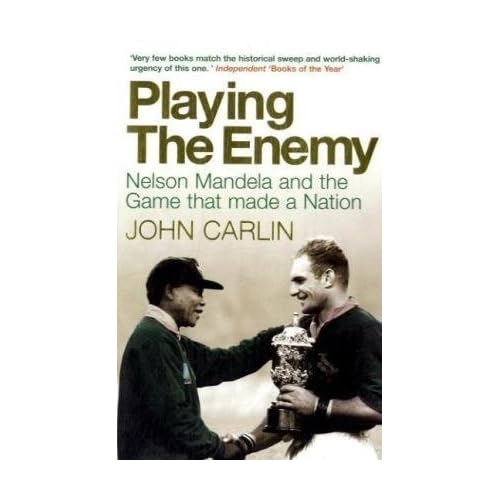
A few weeks ago I read John Carlin's excellent book Playing the Enemy. It tells the story of Nelson Mandela's project of nation building in post-apartheid South Africa, climaxing with the 1995 Rugby World Cup final.
It's rare that a retelling of events in recent history that are in my own living memory can evoke as much emotion as they did at the time. John Carlin's book almost moved me to tears as I was led to appreciate the great significance of the events that formed the Rainbow Nation. I understand the book is to be made into a film, and I should imagine that it will transfer across media very well.
The book is really a biography of Mandela himself. He is represented as a political genius - using his charm and charisma pragmatically to achieve what he wanted, and being very aware of his surroundings. Mandela is quite a hero of mine, and whilst the book sometimes overstates his saintlike qualities, I felt I understood him further after this sketch.
One of the things that I've found myself responding to time after time is Mandela's strategy to always expect the very best to come out of a conversation, even those in situations of confrontation. Time and again, Mandela seems to go beyond reasonable expectation in giving his opponents the benefit of the doubt. He seems to assume that people are generally good - undoubtably corrupted by other influences - but good nonetheless. Here's a case in point of Mandela at work, responding on radio to one far-right opponent Eddie von Maltitz:
For a full three minutes he [von Maltitz] ranted and raved at Mandela - communism that, terrorists the other, the destruction of our culture, civilised standard, and norms. He ended with a brutally direct threat. "This country will be embroiled in a bloodbath if you carry on walking with the Communist thugs." After a tense pause, Mandela replied, "Well, Eddie, I regard you asa worthy South African and I have no doubt that if we were to sit down and exchange views I will come closer to you and you will come closer to me. Let's talk, Eddie." "Uh... Right, okay, Mr. Mandela," Eddie muttered in confusion. "Thank you," and he hung up. [page 151]
I've been made to return to Mandela's strategy on several occasions in recent days. I wonder if often tense meetings would be made easier if we gave our opponents the benefit of the doubt as Mandela did. Mandela's theology seems to imply universal goodness and evil systems. A closer Biblical theology is of universal depravity of all human hearts. But I wonder whether our understanding of this true theological diagnosis of the heart sometimes causes us to put limits on the common grace he has placed into the hearts of all humans, and leads us into unnecessary confrontation and arguments when they might be diffused.
I have been struggling for days with feelings of anticlimax. I've found these feelings highly disconcerting and pretty exhausting.
This isn't the first time that I think I've struggled with anticlimax. About five years ago, the week after a CU mission I had been highly involved in organising was perhaps the week in which I struggled most as a Christian and was my sharpest period of doubt so far.
This time round I've found myself not doubting the gospel as much as being self-obsessed. I think this is linked to being in a period of flux and change - finishing as a Staff Worker in Lancashire, preparing to move eastwards as Team Leader with UCCF, having to say a whole suite of goodbyes and preaching on some emotionally-demanding passages. The way in which this self-obsession has shown itself has been constantly comparing where things are with how I imagined them to be, and comparing where I imagined things would be relationally with a whole number of individuals with where they actually are. I've scared myself with how God-less these thought patterns have been, and the pride and despair that I've found myself being sucked into. All of this has been tiring, and I've really felt the devil on my back.
Like all periods, over recent days I've had to preach the gospel to myself. I've been blessed by the Lord's kindness in helping me. Singing songs about the cross on Tuesday night helped me lift my eyes from myself and back to Jesus. A conversation with a minister friend this morning spoke truths back into my life. And I was encouraged to a more helpful and God-centred viewpoint of my circumstances by Psalm 29 in my own Bible time this morning.
Anticlimax isn't something we often talk about or think about. But it is powerful. And I think, like grief, anticlimax is an important period through which we adjust to changes in our surroundings. Like grief, though, it's important to ensure that our emotions are ultimately surrendered to Jesus' Lordship and to his gospel. Just as we don't mourn as the pagans mourn, so it seems to me that disciples of Jesus shouldn't suffer anticlimax like others around us.
The LORD sits enthroned over the flood; the LORD is enthroned as King forever. The LORD gives strength to his people; the LORD blesses his people with peace. [Psalm 29:10-11]
I've been reflecting recently on how certainty is often considered uncool at best and arrogant at worst when talking about spiritual issues. The Bible speaks of confidence, of certainty and of being sure - yet to many people, this appears to be a boring turn-off.
Many people are suspicious of confidence. They're suspicious partly because it sounds as though it could be dull. We are surrounded by seemingly heroic people who are on a spiritual quest into the unknown – and Christians say, “We know.” And it sounds like if you become a Christian you’ll never going to go on an adventure again; it sounds like you’re just going to close down your mind and resign yourself to a cosy future with cardigans and slippers and just a small little world.
Actually, it is not knowing that is paralysing. The present economic climate is a great example of this. Whilst there is so much financial insecurity, it's very difficult to make long term plans. It's difficult to embark on an adventure when it feels there's nothing solid to build upon.
Similarly, as long as we are not sure about God, there is a kind of paralysis. We never live lives which are completely hung on the gospel, because we're not sure. We’re not quite sure we want to put all our eggs in his one basket. We feel as those we need to keep our options open; so we live a bit for Christ and a bit for other things as well. And when this is the situation, the Christian life seems very average.
In contrast, when the Bible writers say 'be sure' (and, as I've shown before, the Bible writers want us to be sure), we need to realise that being sure is not the end of adventure, but rather being sure is the beginning of adventure, where the Christian life can really take off! Life knowing the God that made you and redeemed you can really take off in all its richness and joy, because you know you can hang your life on Jesus and your death on Jesus. Hanging your life on Jesus means that you will serve and sacrifice and find joy in a whole range of unexpected places. The adventure really begins.
Here is the text of the last message I gave at Lancaster CU. The table on law and gospel is taken from World Harvest Mission's Sonshipcourse:
As we’ve seen, the book of Nehemiah is all about the work and worship of God’s people, serving in his strength. In the chapters prior to Nehemiah 8 we’ve seen Nehemiah lead his people – the ancient Israelites – in rebuilding the walls around Jerusalem.
Why was Nehemiah so bothered about repairing these walls? Well, it’s because Jerusalem was no ordinary city. Promise after promise in the Old Testament speaks of how Jerusalem is to be the climax and centre-point of all that God does to the nations through Israel. Jerusalem was to be the focal-point of Israel’s worship, where they could model to the world what a relationship with the LORD looked like. And so for the walls to be in a state of disrepair was dishonouring to God and meant that God’s model of blessing the nations – which in turn pointed forward to Jesus and his ingathering of the nations – was broken.
Now, by the time we get to Nehemiah 8 we see that wall has been finished. Miraculously, in just 52 days, this mile of wall around Jerusalem was erected. The Jews had made their witness to the nations. God’s model of heaven on earth had been restored. God has finished repairing the walls; in Nehemiah 8 – which is perhaps the climax of the book – God starts the process of reviving and repairing his broken people. And the way in which God repairs his broken people is through feeding them from his word.
Verse 1 tells us that all the people assembled as one man in the square before the Water Gate on the first day of the seventh month – the Jewish festival month. In today’s calendar, the date would have been 8th October 444BC. We read in verse 2 that the people comprised of the men, the women and all those who could understand (so presumably that means the children who were old enough). In total, there were probably around thirty thousand people, gathered together.
And if you’d been in backstreet Jerusalem that day, I guess you might well have asked, ‘What’s going on? Thirty thousand people! Is it a football match? A rock concert? What would draw thirty thousand people to gather as one man?’
Well, a guy called Ezra comes out onto a stage specially built for the occasion. And he has an entourage next to him – verse 4 – not backing vocalists, but other priests. It’s as if Ezra is showing that he is not going to do anything on his own authority, he doesn’t want the glory here. The whole thing is set up for a spectacular occasion. But the crowd are not there for a gig or a football match, they are there to hear the Book of Moses read – the first five books of the Bible: Genesis and Exodus, Leviticus, Numbers and Deuteronomy. They’re there to hear them read and explained.
Well in verse 1 the crowd began chanting for Ezra to get cracking (Imagine: ‘Ezra! Ezra! Ezra!’). Ezra 7:10 describes the man in this way: ‘Ezra had devoted himself to the study and observance of the Law of the LORD, and to teaching its decrees and laws in Israel.’ Ezra is the Bible teacher, Ezra is the one that the people know they need to expound God’s Word. And it’s just worth noting that, at this point, Nehemiah is happy not to be centre stage. As I was preparing this message, I was wondering if I would have been as humble as Nehemiah. After all, Nehemiah has been the main man up until this point. But, gifted as he is, Nehemiah knows that his gifting is in leadership and in administration. Ezra’s gifting is in teaching Scripture. Nehemiah knows that God has distributed different gifts to different individuals in his people: up to this point, primarily Nehemiah has been serving Ezra through leading the rebuilding of the walls of Jerusalem. Now Nehemiah turns to Ezra, knowing his gift, and says, “Serve me and the rest of God’s people through feeding me with God’s Word.”
What makes this hunger for God’s Word particularly noteworthy is the context. Remember, the people of Judah have been in exile for many years. Not only that, but the society was an oral one – most people would neither have been able to read or have ever heard the Law of Moses read in any venue. And now, in the safety of the completed walls of the city of Jerusalem, the people gather expectantly to hear from God.
And look at the depth of hunger for God’s Word that the Lord has instilled in his people. Look at verse 5: ‘Ezra opened the book. All the people could see him because he was standing above them; and as he opened it, the people all stood up. Ezra praised the LORD, the great God, and all the people lifted their hands and responded, ‘Amen! Amen!’ Then they bowed down and worshipped the LORD with their faces to the ground.’
Look at the passion that emanates from the hearts of the people. The LORD has placed into their hearts a thirst to hear from him. The apostle Peter wrote in the New Testament to churches saying that they should crave pure spiritual milk like newborn babies’. And that’s what the people are doing here. The people stand up as Ezra opens the book – it’s like a sign of respect; they’re waiting to hear what Scripture says. Then as Ezra prays, the people lift their hands. Lifting hands in the Old Testament is a physical way of saying to God, ‘I am completely submitted to you. I am humbly dependent on you. Let nothing get in the way of you speaking to me and my right response to you.’ It’s one of the reasons that some Christians raise their hands now. And then as the prayer ends, the people shout, ‘Amen! Amen!’ They are shouting, ‘Yes, Lord! I agree!’ to Ezra’s prayer that God would speak to them. As Scripture is opened, the people are not passionless or looking to intellectually assent to what they are hearing. They are arriving expecting to hear from the living God, expecting to meet with him through his Word. These guys have arrived to hear the Word of God, with energetic and conscientious listening. They are not texting each other as Ezra speaks, they are not preoccupied with other things. And verse tells us that for six hours they absorbed everything that Ezra has to say.
Can you imagine a six hour sermon? You have to love the Bible to stand reverently and attentively for six hours, no toilet breaks, no coffee breaks. Just standing and listening to God speak. But these Israelites were pleased to do it. The lure of the football on TV couldn’t keep them away.
Their attitude to the Bible is very much like that which is described in the Law of Moses which Ezra was reading to them. In Deuteronomy 8:3 Moses declares: “Man does not live on bread alone but on every word that comes out of the mouth of God.” It’s a very good description of the scene in Nehemiah. It’s the picture of hungry beggars waiting for crumbs that are dropping from the King’s table. And every single word that falls from the mouth of God is food for these people. They are feasting on God’s word. Nehemiah 8 is about thirty thousand people who crave to hear God speak to them more than any earthly thing. They longed to know God.
Too often we take the Bible for granted. Just think of it. In the Bible, the God of the Universe is offering himself to you. The God of the Universe has commissioned a self-portrait called the Bible. The Father has asked the Holy Spirit to write, through the Bible writers, a rendered biography of his Son Jesus Christ, the exact image of his Father. So the Father has given this Spirit-inspired account of His Son, and he’s done it because he wants to be known. He wants to speak into your life – to introduce you to his wonderful Son and so to realize the wonder of his love.
How will God speak into your life? God speaks as the Bible is read and proclaimed. Do you see that in verse 8? Whereas in verse 1, it was called the Book of the Law of Moses – in verse 8, Nehemiah is absolutely clear that it is also ‘the book of the Law of God.’ Moses might have been the human writer – but God, by his Spirit, is the ultimate author. And just as he used Moses to write the Bible – so he uses people to communicate the meaning of the Bible. We see in verse 7 there were many who were employed in the task of making God’s voice heard and understood – preachers or small group leaders if you like. In verse 8, ‘they read from the Book of the Law of God, making it clear and giving the meaning so that the people could understand what was being read.’
The Bible should not simply be read; it should be proclaimed and understood. And this is a wonderful thing. The Father does not simply send down the Bible like a textbook and expect us to study it on our own. So often people complain that they can’t get a handle on the Bible and they need help. And I want to say – yes you do need help – we all need help, and God gives us help. He gives us help through the Holy Spirit, the co-author or the Bible, and he gives us help through giving us the church: preachers and small group leaders and others around us to help us understand God’s word for ourselves.
Well what is the effect of hearing God speak in this way? Look at verse 9 with me: “All the people had been weeping as they listened to the words of the Law.”
The Bible had exposed them in their rebellion against the Living God. The Law thundered and convicted the people of their sin – of how they had turned to other things and placed them at the centre of their lives. It convicted them of how they couldn’t saunter into a relationship with God, because they had neglected him that had given them such goodness. They understood this not just individually but corporately: that for so many years the people of Judah had been under a curse because they had refused to hear the LORD’s voice. The Bible brought all this home – and it made them weep.
But Nehemiah says that this reaction to what Ezra had just taught is inappropriate. Look again at verses 9-11:
9 Then Nehemiah the governor, Ezra the priest and teacher of the Law, and the Levites who were instructing the people said to them all, “This day is holy to the LORD your God. Do not mourn or weep.” For all the people had been weeping as they listened to the words of the Law.
10 Nehemiah said, “Go and enjoy choice food and sweet drinks, and send some to those who have nothing prepared. This day is holy to our Lord. Do not grieve, for the joy of the LORD is your strength.”
11 The Levites calmed all the people, saying, “Be still, for this is a holy day. Do not grieve.”
Nehemiah twice says that crying is inappropriate because ‘this day is holy to our Lord’, and the
Levites agree. “It’s inappropriate to be weeping on a day like today,” says Nehemiah. And what was the day? Remember – it’s the Feast of Trumpets, which marked the beginning of seventh month in the Jewish calendar. And you can read in Numbers 29 of the seventh month was the festival month – it was the highlight of the Jewish calendar, jam-packed with festivals and celebrations that spoke of how the LORD rescues and forgives his people.
And so when Nehemiah says that in the light of the people’s conviction of sin that they should rejoice and not grieve, he’s not saying that the people’s sin doesn’t matter. Nor is he saying that times of grief and mourning about sin are wrong. Rebellion against God does matter: it breaks relationship with him. And sorrowful confession of sin is part of how we ensure that our hearts remain truly penitent and God centred. No, what Nehemiah is saying is that to see sin against God – to see the Law – as the end of the story to have a wrong view of the big picture. In the New Testament, it’s quite obvious that the Law isn’t the end of the story. But it’s also there in the Old Testament too. And part of this was the institution of various holidays where, in spite of their sin, God encourages the people to rejoice at their relationship with him. It’s a pointer that, one day, he will deal with sin once and for all. The law leads people to Jesus.
And so back outside the Water Gate in Jerusalem, Nehemiah says to the assembled throng: ‘Guys – it’s the Feast of Trumpets. It’s the celebration of the beginning of the seventh month – the month which speaks of how sin isn’t the last word. So stop grieving and start celebrating!’
It would be a bit like meeting someone on Easter Sunday that is gloomy and miserable. You ask them why, and they say, “Because of my sin, Jesus ended up on the cross.” And whilst that’s right and true, you’d want to say, “But it’s Easter Sunday! Today we’re remembering our wonderful Saviour and Redeemer who took our judgement and beat death. Mourning sin today isn’t appropriate.” Law isn’t the end of the story; sin isn’t the end of the story. And where sin abounds, God’s grace shown to us in Christ abounds all the more.
But so often today we can slip into thinking the Law is the end of the story, constantly making its demands. And when do so is miserable. We give the Law a place it should never have had. Have a look at this table:
Law is good because it...
Law is powerless because it can never...
Shows us how our faith should express itself
Maintain our relationship with God and others
Shows us what Jesus is like
Give us righteousness
Reveals the character of God
Justify those who break it
Brings sanity, wisdom and direction
Free us from bondage, guilt and corruption
Drives us to Christ and his Spirit
Give us power
Restrains wickedness
Give us life
Convicts of sin
Provide us with a substitute
Is written on our hearts
Give us the gift of the Spirit
Is part of love
Can cleanse our conscience
And what Nehemiah is doing, in a manner of speaking, is showing the people around him this table, or flipping open his copy of God’s Big Picture. He’s encouraging the people to see the broader picture of the Bible. And so Nehemiah pronounces an order to rejoice. “Do not grieve” he says “for the joy of the LORD is your strength.” In spite of your rebellion – there is forgiveness in the LORD, therefore rejoice. Go! Enjoy a barbecue, and make sure there’s plenty of food for the poor around – the God of the universe knows what you’re like and he loves you anyway. If that’s not cause for a generous celebration, I don’t know what is. And these Israelites went out rejoicing in the LORD. The Bible had taken them to weeping and mourning and then to rejoicing and celebrating. God is repairing his broken people.
It is the pattern of every great adventure story. All adventure stories follow the same sort of pattern. You know: there are some ordinary people living ordinary lives and they are plucked out of their ordinary circumstances and transported to another land, another kingdom, another world, another planet, where they are caught up in a cosmic battle of good and evil. And there are dangerous baddies and there are wonderful heroes and at the end there is a decisive battle fought and the good guys snatch victory from the jaws of defeat. And at the end of the book the heroes are placed back in their ordinary lives, but now they are changed. They are stronger, braver, more caring, more centred, more joyful. Why? Because they had been caught up in something more grand and important than they had ever experienced before. Now their everyday lives take on a new perspective.
It’s the same as we come to the pages of Scripture. As we read the Holy Spirit’s history of the world, it is a cosmic tale of good and evil and victory in the Lord Jesus Christ. And the believer in Jesus is caught up in the events of the Bible. We were in the enemy camp – waging war against Jesus and deserving eternal death – but Jesus in His mercy has come and died in our place and scooped us up in the resurrection and brought us into the family of God to worship him as King and sing his praises forever. What a story!
This is something that God’s people at the time of Nehemiah tasted as his word was taught, because they now had caught sight of God’s purposes. Or as verse 12 puts it, ‘they understood the words that had been made known to them.’ And how does this show itself? It shows itself through a hunger for God’s word that sees them returning day after day so that Ezra can continue to feed them. And – beautifully and ironically – the chapter ends with the people making temporary shelters, as required in the Law for the Feast of Tabernacles. This was a festival to remind the Israelites that they are strangers and aliens in the world. The people are home, at last, in Jerusalem – but, as God’s word feeds them, they are reminded that they are not truly home. As Hebrews 11 puts it, they were being reminded that they could look forward to a city with foundations whose architect and builder is God. They were in the earthly Jerusalem, but God was reminding them of his rescue that meant they could look forward to the heavenly Jerusalem forever. That is where history is heading. That is the big story.
But I have to ask you: are you immersing yourself in this story? Are you daily reminding yourself of reality? Are you daily making room for God to feed you and speak into your life? Are you placing yourself regularly under God’s word? Will you, over the summer and upon graduation? If you’re not, then the gaps you’re leaving in your life won’t be left empty – they’ll be filled by other things. And you’ll find that although you nibble on snacks to satisfy the hunger in your life, your appetite for the truly satisfying meat that only God offers will diminish. It is a dangerous thing to neglect the word of God. But it’s also a stupid thing. Look at verse 10. Don’t you want verse 10 to be a reality in your life? “The joy of the LORD is your strength”? The highway to a joyless existence is one cut off from God’s gracious word to us. If we refuse to listen to God’s word, we’re like the sullen child who pokes his fingers in his ears while his parents try to tell him of a wonderful holiday.
The Word of God brings life and salvation. Through it, the Holy Spirit declares that all our sins can be forgiven in Jesus, if only we will cast ourselves on him and believe in him. If we would unblock our ears and listen there would be tremendous joy. The minute we think life is about striking out on our own we enter a very joyless and peaceless existence, which is profoundly dishonouring to God and miserable for us. And the minute we think life is about our approach to God (rather than his approach to us) we lead the unhappy life of the one under the Law. But when we understand that the Bible declares to us Jesus Christ’s approach to us, to bring light and life, then the joy of the LORD will be our strength. And we will find strength to live for him, whatever the cost.
Putting the Bible at the centre of our lives is crucial to understanding the wonderful grace of God. The Bible is where the Holy Spirit gives to us Jesus Christ and in him all the goodness and grace which the Father longs to grant his creation. If we want to be people of enduring and God-glorifying joy – a quality of joy that demonstrates that only God offers what humans like us need – then we must constantly hear the Spirit speak God’s good news to us through his Word. We must constantly allow ourselves to be repaired and transformed as the Spirit’s sword frees us and makes wounded people like us whole, as it made the wounded and broken people at the time of Nehemiah both free and whole.
This is my final message at Lancaster University CU. We’re in a time in this country where it seems to me fewer and fewer Christians are taking the Bible seriously and letting the Spirit use it to rip roar in our lives and bring us radically to Jesus. Too often we settle for impoverished sermons, Christian books that are more like self-help manuals than Scriptural truth, and suffer from a lack of hunger to actually grapple with and be transformed by the word. But I love you all very much and so my prayer for all of you for the rest of your lives is that you will continue to be people of the book, that Lancaster CU will be characterised by holding firm to the word of life, and that each of you as individuals will make time to hear God speak. I pray that the written word will continue, through the power of the Spirit, to reveal Jesus, the Living Word. And that as you see him more clearly, the joy of the LORD will be your strength, and that this will cause you to live radically. That as the joy of the LORD is your strength, and as you see knowing Jesus to be the supreme blessing, you will willingly suffer, you will willingly love people radically and sacrificially, and that you will make brave decisions for Jesus and his gospel, knowing that living wholeheartedly for Christ is never in vain.
Sign up for our prayer&news letters
-
If you’d like to sign up for our prayer&news letters, please fill in your
contact details below and we’ll add you to the distribution list.
11 aspects of being made in the image of God
-
Here are 11 things the early chapters of the Bible say about being made in
the image of God. they all depend on God being prior, above and
qualitatively ...
Teach us to pray
-
That was the question the disciples asked Jesus and which people have been
asking ever since. I've met very few Christians who feel they have an
adequate ...
A Tale of Two Unis
-
Yesterday I went to speak at a lunch bar talk for the Bournemouth
Universities CU Mission Week. The CU in Bournemouth is made up of students
from the tw...
FIEC Conference - Evangelism
-
*(This first appeared in the November edition of our church magazine
called the Grapevine)*
At the start of November I was at the FIEC (Fellowship of Ind...
Review of Alister McGrath, Inventing the Universe
-
A media dream (despite its lack of substance, it was certainly a
sensation), New Atheism continues to sell. It seems we can't stop talking
about science,...
Every story whispers his name
-
Since my first son was very young Sally Lloyd-Jones' The Jesus Storybook
Bible has been staple reading in our house. We've probably read it 60-70
times t...
New blog
-
I'm no longer blogging at this site (incase you hadn't noticed!), but I
have a new blog now with Cathy, over at:
http://www.gospelcentredparenting.com Chec...
Subscribe to the new Blog
-
If you’ve already subscribed to this WordPress blog (or even if you
haven’t!), you may have noticed that not a lot is happening round here… But
all is not ...
CHARITY SHOP
-
The long-delayed plans for the Charity Shop in Cluny Sqaure is now
approaching realisation.Funds from the ROSCA Trust have enabled the
refurbishment of the...
5 words that sum up every biography
-
"Five words sum up every biography -
*Video meliora proboque, deteriora sequor*
I see and approve the good, but follow the bad"
Aldous Huxley
Pick your own theology of baptism!
-
If baptism is an "an outward and visible sign of an inward and spiritual
grace" (BCP), then we can ask three questions, from which I think you can
identi...
Preaching When you know it'll hurt…
-
What to do when the text before you will wound the people who will sit and
stand to listen to you? You know it will provoke pain in those of tender
conscie...
Seeing the light
-
Cambridge is one of the most beautiful cities I get to go to regularly with
work, and so when I saw these postcards of the rather less beautiful
aspects I ...
Life Experience
-
Do you ever just sometimes feel like you want to get through more of your
life, more quickly, in order to be that interesting experienced person
already wh...
Beautiful things
-
This song is beautiful. Have a listen. And drink in the words.
*'All this pain, I wonder if I'll ever find my way, I wonder if my life
could really change ...
New Directions
-
(For anyone who didn't realise, the title of this post is a direct but
relevant reference to Glee, one of my favourite TV shows, in which the
featured show...
Hallam CU: So long, farewell!
-
I just got back from what was my last ever Hallam Christian Union meeting.
They got me a cake and present to say goodbye, it was really touching. I
got hom...
Total depravity and truly gracious salvation
-
Something I've heard a lot recently and that seems to be in the phrase-book
of some evangelists is that God gives us free will to either choose him or
reje...
Trusting (Psalm 13)
-
Psalm 13
For the director of music. A psalm of David.
1 How long, O LORD ? Will you forget me forever?
How long will you hide your face from me?
2 How lo...
4 Ways to Love Michael Scott
-
So I’ve recently been watching the American Office. I thought as a
Christian, how would I love someone who is perhaps the most socially
arkward on televis...
Evolution and Evangelism
-
Evolution is a secondary issue
1. Evolution and naturalism are not the same thing
Belief in evolution as a process is very different from the all
encompass...